








Numerical Simulation and Process Research on Forging of Large Shaft Forgings
- Views:0
- Author:
- Publish Time:2026-03-19
- Origin:
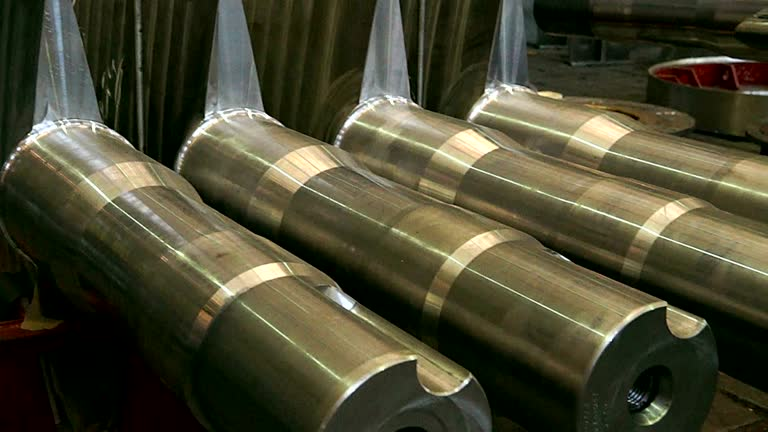
Large forgings are the core basic components for the development of heavy industry, widely applied in marine engineering, military industry, aerospace, iron and steel manufacturing and heavy machinery equipment. As the key core parts of various equipment, large shaft forgings have extremely strict quality requirements for their manufacturing process. The rationality of the forging process directly determines the shape, size and comprehensive performance of the forgings, and is crucial to the final product quality.
Based on the traditional forging process of shaft forgings in a heavy industry enterprise, our research team adopted the finite element simulation technology and orthogonal test method to carry out in-depth research on the forging process of large shaft forgings, optimized the forming process parameters, and provided a reliable technical reference for the actual production of enterprises, while effectively reducing energy consumption and production costs. The research results have important guiding significance for the high-quality production and export of large shaft forgings.
1. Numerical Simulation Parameter Setting and Orthogonal Test Scheme Design
1.1 Basic Simulation Settings
We first established the 3D models of billet and die by UG software, exported them in STL format and imported into DEFORM-3D to define their spatial relationship. The billet material was selected as AISI-4340 (40CrNi2Mo steel), a high-performance alloy steel with excellent strength and toughness, widely used in the manufacturing of high-end heavy machinery parts. The billet was set as a plastic body, the die as a rigid body (the upper die is the movable main die), and the ambient temperature was set at 20℃.
1.2 Orthogonal Test Design
Aiming at the problems of large workload of full factorial test in the research of forging process parameters, we adopted the orthogonal test method to efficiently study the multi-factor and multi-level problems. Combined with enterprise production experience and numerical simulation practice, billet heating temperature (A), main die speed (B) and friction coefficient (C) were selected as the test factors, with forming load as the evaluation index for process optimization. The first process simulation was completed in DEFORM-3D, and the factor and level settings of the orthogonal test are shown in Table 1.
Table 1 Factors and Levels of Orthogonal Test
Level | Billet Heating Temperature (℃) | Main Die Speed (mm·s⁻¹) | Friction Coefficient |
1 | 1140 | 10 | 0.3 |
2 | 1200 | 20 | 0.5 |
3 | 1260 | 30 | 0.7 |
We carried out 9 groups of orthogonal tests, and the detailed test scheme and forming load results are shown in Table 2. K1, K2 and K3 in the test results represent the sum of test indexes of each factor at level 1, 2 and 3 respectively, and R is the range. The larger the range, the more significant the influence of the factor on the forming load.
Table 2 Orthogonal Test Design and Results
Scheme No. | Factor Combination | Billet Heating Temperature (℃) | Main Die Speed (mm·s⁻¹) | Friction Coefficient | Forming Load (×10³t) |
1 | A1B1C1 | 1140 | 10 | 0.3 | 3.97 |
2 | A1B2C3 | 1140 | 20 | 0.7 | 7.96 |
3 | A1B3C2 | 1140 | 30 | 0.5 | 9.16 |
4 | A2B1C3 | 1200 | 10 | 0.7 | 3.05 |
5 | A2B2C2 | 1200 | 20 | 0.5 | 5.79 |
6 | A2B3C1 | 1200 | 30 | 0.3 | 8.40 |
7 | A3B1C2 | 1260 | 10 | 0.5 | 2.40 |
8 | A3B2C1 | 1260 | 20 | 0.3 | 4.57 |
9 | A3B3C3 | 1260 | 30 | 0.7 | 6.96 |
Table 3 Mean Value and Range of Forming Load
Factor | K1 (×10³t) | K2 (×10³t) | K3 (×10³t) | Range R (×10³t) |
Billet Heating Temperature (℃) | 7.03 | 5.74 | 4.64 | 2.39 |
Main Die Speed (mm·s⁻¹) | 3.14 | 6.10 | 8.17 | 5.03 |
Friction Coefficient | 5.64 | 5.78 | 5.99 | 0.35 |
The range calculation results show that the main die speed has the most significant influence on the forming load (R=5.03×10³t), followed by the billet heating temperature (R=2.39×10³t), and the friction coefficient has the smallest influence (R=0.35×10³t). Based on the test results, the optimal process parameter combination for minimizing the forming load was determined: billet heating temperature 1260℃, main die speed 10 mm·s⁻¹, friction coefficient 0.3.
2. Analysis of Numerical Simulation Results
2.1 Forming Load Curve Analysis
The stroke-load curve of the forging process shows that the load change is stable during the forging process. When the die is initially pressed down, the load rises gradually after contacting the billet; with the decrease of billet temperature and the increase of die feed, the metal deformation resistance increases, leading to a gradual rise in the required load. The stable load change ensures the uniformity of the forging forming process and avoids the quality defects caused by sudden load changes.
2.2 Stress and Strain Analysis of Key Processes
2.2.1 Equivalent Strain Analysis
The equivalent strain distribution of upsetting, stretching and rounding processes directly reflects the deformation intensity of the billet. In the upsetting process, deformation is mainly concentrated on the surface of the forging, and the central compression is small, which is easy to cause defects such as coarse grains, inclusions and looseness in the core. We take the core equivalent strain ≥ 0.2 as the evaluation standard for forging penetration, which is the key index to ensure the internal quality of large forgings.
The simulation results show that the core strain of the first pass upsetting meets the standard of ≥ 0.2, realizing effective forging penetration of the billet core; after multi-pass processing, the overall strain of the billet increases, the core strain reaches 1.19~1.55 in the stretching process, and further rises to 10~11.2 in the rounding process, with uniform strain distribution in all processes, which fully verifies the rationality of the optimized process parameters.
2.2.2 Equivalent Stress Analysis
Large forgings take steel ingots as billets, and internal defects such as shrinkage cavities, looseness and segregation are easy to exist in steel ingots, and stress concentration is easy to occur at the defect edges. The residual tensile stress in the core after steel ingot solidification will aggravate the defect expansion. The research shows that the triaxial compressive stress state is the most favorable for improving the quality of forgings, which can effectively inhibit the generation and expansion of cracks and promote the welding of internal holes.
The simulation results of the stress distribution in X, Y and Z directions show that the interior of the forging presents an ideal and uniform triaxial compressive stress state, which effectively solves the problem of internal defect expansion in the forging process of large shaft forgings and ensures the internal quality of the forgings.
3. Process Verification
Based on the numerical simulation results, we carried out the trial production of large shaft forgings in cooperation with heavy industry enterprises, and the actual forming conditions were completely consistent with the simulation conditions. The on-site production and final product detection results show that the surface quality of the forged shaft forgings is excellent, the internal structure is uniform, and all shape and size indexes meet the enterprise production and export quality requirements. The trial production successfully verified the practicability and reliability of the optimized process parameters in actual production.
4. Research Conclusions
Combined with production experience and numerical simulation, the orthogonal test method was used to optimize the billet heating temperature, main die speed and friction coefficient. Taking the minimum forming load as the goal, the optimal process parameters were determined: billet heating temperature 1260℃, main die speed 10 mm·s⁻¹, friction coefficient 0.3, which can effectively reduce the forming load and production energy consumption.
Forging penetration is the key of the upsetting process. With the core equivalent strain ≥ 0.2 as the forging penetration evaluation standard, the core strain after the first pass upsetting meets the requirement, indicating that the process parameter design is reasonable and can realize the effective forging penetration of the billet core.
The triaxial compressive stress state is conducive to inhibiting the generation and expansion of internal defects of forgings and improving the internal quality of forgings. The simulation results show that the interior of the forging presents a uniform triaxial compressive stress distribution, which further verifies the rationality of the optimized process parameters.
About Our Forging Products Export
We are a professional manufacturer and exporter of large forgings, focusing on the R&D, production and export of shaft forgings, cake forgings and plate forgings made of AISI-4340 and other high-performance alloy steels. Our products are widely exported to the global heavy industry field, with strict quality control and advanced forging process guarantee. Based on the latest research results, we continue to optimize the production process of large shaft forgings, improve product quality and production efficiency, and provide high-quality, high-performance forging products and customized technical solutions for global customers.
For more information about our forging products and export business, please contact our professional team.


